.: --INTERNET--
Showing posts with label --INTERNET--. Show all posts

Saturday, March 19, 2016

Google now lets you put stickers on Maps. Read More...


As you may know, you can label your Home and Work places on Google Maps for easy access to them. Thanks to an update rolling out now to the Android app, you can also add custom stickers to these locations - just in case you want to mark your house with a yellow submarine.
First, you need to designate these locations in Google Maps, which you can do by pulling up a card for somewhere and then picking Label. Type in "home" or "work" and you then get the option to add these markers to the places you've picked.
Once a place is labelled, you can choose from a range of preset icons (there's no way to add your own yet). Google says it's so you can make Maps "a little more you", but it does help in spotting your home or office from a distance.
Google also points out you can add all kinds of custom labels - school, gym, Uncle Ted's and so on - to make using Maps more convenient. These place nicknames will show up in Maps to save you having to enter addresses each time.

Friday, February 26, 2016

Facebook May Launch Risky Messenger Ad Program


Facebook has been preparing to push personalized ads through its Messenger app, according to a report last week in TechCrunch.

The company will allow brands to send their own marketing materials through the popular chat app, suggests a leaked document apparently intended for Facebook's advertising partners.
The changes could go into effect during the second quarter of the year.
It's not clear what the ads would look like. Companies might be able to use the system to deliver video and graphical content that would detail their offerings to consumers. They also could use reminders to prompt purchases, announce new products and services, send notifications of flash sales, and provide links to 

Down to Business

Instead of sending a stream of ads after people in Messenger, Facebook will leave the matter between users and brands. Brands will have the ability to send ads only to users who have initiated conversations with them, a claim that's backed up by the launch of a URL: fb.com/msg/.
Businesses would tag their Facebook usernames to that end of that URL, and that would serve as a link to chats between companies and customers. It's an expansion of Facebook's efforts to facilitate customer service exchanges on its networks, doing so in a private chat rather than on a public page.
That just might be a lucrative way for Facebook to monetize Messenger, according to Karma Martell, president of KarmaCom.
"If Facebook can insert itself as a bridge to better and faster customer service, they will stand to make a fortune," she told the E-Commerce Times.
"They could have hit on a value add-to-customer ad sales holy grail. It could be an amazing brand loyalty and brand-building tool if it is beta tested with a short list of brands and power users, tweaked and then rolled out," Martell said.


Ad Avoidance

Standing in the way of the plan's success is a phenomenon that has curtailed the profits of websites: ad blockers and advertising avoidance in general, according to Jennifer M. Grygiel, assistant professor of communications/social media at the S.I. Newhouse School of Public Communications at Syracuse University.
"At this point, most people will have had several bad experiences with advertising in social networks," she told the E-Commerce Times. "Facebook needs to be conscious of this and get it right out of the gate. Otherwise, there will be a lot of backlash from users."

Facebook TIPs the Scales Toward Better Networking


Facebook on Sunday at the 2016 Mobile World Congress announced its Telecom Infra Project, an engineering initiative aimed at developing new technologies and approaches to building and deploying telecom network infrastructure.
TIP will bring together telecommunications companies, infrastructure providers, system integrators and other technology companies, according to Jay Parikh, Facebook's global head of engineering and infrastructure.
In essence, Facebook wants to become a provider hub of globally shared content.
People and devices are coming online in increasing numbers around the world, making it easier to share data-intensive experiences such as video and virtual reality, Parikh said. However, the industry has been too slow in scaling traditional telecom infrastructure to meet the global data challenge.
If TIP is successful, it could be a game-changer. Content is and always has been king, and Facebook needs the telecommunications providers to efficiently deliver content, said Michael Bremmer, CEO of TelecomQuotes.com.
"Facebook is changing the game because telecom is dominated by players who do not want the game to change and are not used to actual competition," he told LinuxInsider.

Possible Fly in the Ointment

However, the major telecom suppliers are concerned about lowering their profitability and have been unable to find other ways to monetize their assets, according to Bremmer.
"This is an industry that literally still thinks in billing by the X -- long distance, byte, etc.," he said.
TIP's task will be to enable telecom operators and the broader telecom industry to be more flexible, innovative and efficient in order to expand connectivity, according to Parikh.
It is tied into Facebook's other connectivity efforts already underway through Internet.org.

An Open Concept

The endgame is to get better wireless networks, and Facebook is calling on a previous play to drive its plan forward: the Open Compute Project, which led telcos to rebuild the hardware that powered data centers.
TIP members will align their efforts to contribute designs in three areas: access, backhaul, and core and management. The initiative will apply the Open Compute Project models of openness and disaggregation to spur innovation, noted Parikh.
Facebook hopes to unbundle the closed system of component pieces that make up the network and give network operators more flexibility in building networks. It also will result in major gains in cost and operational efficiency for both rural and urban deployments, Parikh said.
The announcement is an interesting move that says as much about Facebook's growing stature and influence as it does about the increasing overlap between technologies and vendors' market strategies, according to Charles King, principal analyst at Pund-IT.
"An ongoing problem in IT is the lack of consensus/collaboration among competing parties. If Facebook can get vendors to play nice and work together, chances are good that technological evolution and innovation will accelerate," he told LinuxInsider.


Here Comes 5G

If the plan works, it could speed the emergence of 5G networks and related services.
"That is something many in the industry are hoping for, though I think translating that into profitable market demand has a long way to go," King said.
Bringing divergent industry players together will be helpful in making 5G a reality, noted Brian Lavallée, director of solutions and technology marketing at Ciena.
"The evolution toward 5G will affect the entire end-to-end network infrastructure, from virtualizing the radio access network and Evolved Packet Core to upgrading the radio and air interfaces to segments interconnecting air-based to land-based networks -- the mobile backhaul network," he told LinuxInsider.
A heterogeneous network of different cell types will be required to obtain aggressive performance gains in speed, latency and coverage. The intelligent utilization of these cell types will result in a highly flexible 5G mobile network architecture optimized for significant, overall performance gains, Lavallée said.

Facebook Wins Either Way

Facebook is in a no-lose position, noted King. If the project succeeds, the company gets praise for its foresight and willingness to play mediator.
"The history of IT is littered with dead or moribund industry collaborations. If Facebook fails, it can bemoan lost opportunities and then get back to the business it knows best," he said.
If it does not work out, Facebook really does not lose much, Bremmer noted. People still want their product and may force the other companies to innovate.
"Facebook's biggest problem is it is an app," he said. "This was proven by the failure of the Facebook phone. Facebook is dependent on others to deliver their content."

Thursday, February 25, 2016

Apple’s battle with the FBI is going straight to Congress


It’s pretty much exactly what Apple asked for in its ongoing encryption dispute with the FBI – the company’s legal representative Bruce Sewell will appear in Congress on Tuesday to argue its case in front of the House’s legal committee.
The director of the FBI James Comey Jr. will appear in an initial hearing, followed later by Sewell, Senior VP and General Counsel at Apple.
Sounding rather more like a movie than an official meeting, the event has been called: ‘The Encryption Tightrope: Balancing Americans’ Security and Privacy.’
Sewell will be joined by Susan Landau, who’s a professor of Cybersecurity Policy at Worcester Polytechnic Institute and an award-winning writer of books including ‘Surveillance or Security? The Risks Posed by New Wiretapping Technologies.’


But the panel will also include Cyrus Vance Jr., New York District Attorney and known critic of encryption and Apple’s security efforts in particular. A report from his office late last year said:
In September 2014, Apple Inc. announced that its new operating system for smartphones and tablets would employ, by default, what is commonly referred to as “full-disk encryption,” making data on its devices completely inaccessible without a passcode. Shortly thereafter, Google Inc. announced that it would do the same.
Apple’s and Google’s decisions to enable full-disk encryption by default on smartphones means that law enforcement officials can no longer access evidence of crimes stored on smartphones, even though the officials have a search warrant issued by a neutral judge. 
Apple and Google are not responsible for keeping the public safe. That is the job of law enforcement. But the consequences of these companies’ actions on the public safety are severe.
It is not clear yet what this will mean for the ongoing court case in California, which Apple is supposed to submit its response to by Friday.
Update: Apple responded by filing a motion to vacate the original order.

Mark Zuckerberg tells employees to stop defacing ‘Black Lives Matter’ statements at work


At the Mountain View Campus of social networking platform Facebook, there’s a longstanding landmark called the signature wall designed to be a visual representation of the growing community at the company. But,according to Gizmodo, it’s also been the site of troubling racial conflicts.
In an employees-only private message on Facebook by CEO Mark Zuckerberg, it seems that unknown employees have taken to crossing out ‘Black Lives Matter’ statements written on the wall– a tribute to the power social media activist movement designed to show the disproportionate amount of police brutality towards the African American community — and replacing them with ‘All Lives Matter.’
And it’s happened more than once.
“Despite my clear communication at Q&A last week that this was unacceptable, and messages from several other leaders from across the country, this has happened again,” Zuckerberg wrote to employees. “I was already very disappointed by this disrespectful behavior before, but after my communication I now consider this malicious as well.”
Zuckerberg also highlights the crux of the tension that surrounds the ‘All Lives Matter’ concept: by countering ‘Black Lives Matter’ (which has an implied ‘too’ at the end of it to indicate that, yes, black lives should be treated with the same respect and dignity as other lives) with ‘All Lives Matter,’ an act of silencing and censorship takes place.
Clearly, yes, all lives matter, but America’s recent past indicates that black people are unfairly brutalized and killed in situations that other (namely white) people could walk away from unscathed.
In short, countering with ‘All Lives Matter’ is woefully mistaken at best, and maliciously racist at worst.


The troubling behavior coming out of Facebook HQ comes despite the fact that the company has been trying desperately to grasp and some semblance of diversity within its ranks. It has poured concerted time and effort into its Managing Unconscious Bias program, eager to help open the minds of its employees and become a more inclusive work environment for everyone.
But, as it turns out, perhaps there is a more conscious, on-the-surface bias that Facebook will need to address as well.
As it stands, just two percent of Facebook employees identify as black — and that number dips to just one percent in tech roles. By formally sounding off not once, but twice, Zuckerberg makes a clear statement that he wants those people (and the rest of his staff as a whole) to benefit from an inclusive, supportive community.
But even the best intentions can still encounter pernicious resistance.

Facebook launches interactive full-screen ads called Canvas


At an event in New York today, Facebook launched its newest product for marketers: interactive mobile ads called Canvas, which it first announced back in September.
Canvas is an evolution of the earlier Carousel ads, which allowed users to swipe through multiple product or brand photos if they were interested in more information.
Canvas instead offers full-screen ads – basically complete mini websites designed around specific products. This includes slideshows, descriptions, videos and a scrollable, interactive interface.
12765831_693974300742934_571885871_n


The ads were designed to be fairly unobtrusive for the end user. They look virtually the same as regular ads while on your News Feed (other than a small ‘tap to open’ prompt), but when you click through, the full experience loads quickly. You can return to your News Feed by clicking on the ‘X’ on the top-left corner.
Facebook says test users have responded positively to the ads so far: users spend an average of 31 seconds per ad, and over 70 seconds for the best ones, which sounds like a lot for an ad. Overall 53 percent of users view more than half of the canvas.
Perhaps more importantly, the company is making sure the ads are easy to make. They’re built via a Web interface with a real-time live preview, and no coding or design skills are necessary. It’s worth noting the ads only work on Android and iOS – the company isn’t announcing any fancy ads for the Web interface so far.
Canvas is rolling out globally to any advertisers using Facebook’s Power Editor tool; interested marketers can try it out at canvas.facebook.com for free. For more on how Canvas works, check out Facebook’s announcement post below.

Wikimedia’s Executive Director has just resigned following months of leadership controversy


After a fair bit of controversy over the past few months, which included a sacking, a resignation and a search engine that riled up some anger, Wikimedia Executive Director Lila Tretikov has resigned from her role. Her last day will be March 31, 2016.
The troubles began after Wikimedia announced that it was working on the Wikimedia Discover search engine, which was proposed as a resource to connect the Web’s open information.
In early iterations, Wikimedia said it would “be the Internet’s first transparent search engine, and the first one originated by the Wikimedia Foundation,” so there was some confusion about whether the organization planned to challenge Google or not. Wikimedia now says it has no intention to do that.
In particular, the company had applied for a $250,000 grant from the Knight Foundation, and many in the community felt that if a wider consultation had been conducted, the resources could have gone elsewhere.
This was just the most recent in a series of conflicts at the organization, including the board voting to remove a a community-elected trustee in December, followed by an editorial revolt in January that saw a newly-elected board member, and former Googler, step down after a vote of no confidence.
For her part, Tretikov had apologized for the lack of transparency on Wikimedia Discover – although she doesn’t cite the recent ordeal as a reason for her departure. In her announcement post, Tretikov recaps her efforts to reverse losses in Wikimedia’s editorial community, and states that she will assist in the search for her successor.
To what extent Wikimedia Discovery will live on in her absence remains to be seen.


Update: Here’s Wikimedia Foundation’s official statement on the resignation.
On Thursday, February 25, Lila Tretikov announced she will step down from her role as Executive Director of the Wikimedia Foundation.
“I am both inspired by, and proud of, the many great things we have all accomplished at the Foundation over the last two years, most significantly reversing the loss of our editorial community,” Lila wrote in her email to staff and community. “I would like to thank our Board of Trustees and Advisors, our Foundation staff, as well as the many outstanding community members for their support and encouragement on this journey. I remain passionate about the value and potential of open knowledge and Wikimedia to change the world.”
The Wikimedia Foundation Board of Trustees is working to develop a transition plan that will include appointing interim leadership and initiating the search for a new Executive Director. Lila’s last day will be March 31, 2016.
Lila joined as Executive Director in May 2014 to support the maturation of the Wikimedia Foundation and focus the organization on the needs of its community and users. During this time, the organization has made real progress in these areas. The Foundation has improved organizational performance and product development, released new native apps, editor translation and content quality assessment tools. Many talented members of our staff and community contributed to these accomplishments, and we want to recognize their hard work and commitment to our mission.
“These changes are in motion and I move on with confidence that the Foundation can meet new challenges in a changing environment” said Lila, “I remain passionate about the value and potential of open knowledge to change the world and our ability to continue to lead this change.”
Since it started fifteen years ago, Wikipedia has grown into one of the world’s most important knowledge resources, thanks to the efforts of hundreds of thousands of volunteers around the world. The focus of the Wikimedia Foundation has always been to support that community and the Wikimedia projects, and to help make free knowledge available for the world.
“The Wikimedia’s vision is clear: a world in which every single person can share in the sum of all knowledge. Even as we go through changes, our focus remains on this vision,” said Patricio Lorente, Chair of the Wikimedia Foundation Board of Trustees. “The Wikimedia Foundation has strong leadership and a talented staff devoted to this vision and our movement’s core values. They will continue to support the Wikimedia projects and community, and we are confident that we are well positioned to move forward at this time. We thank Lila for her service and wish her the best in her future endeavors.”
Lila will remain engaged with the Wikimedia Foundation to support the transition process.

FBI reportedly forced researchers to hand over data that exposed TOR users


The FBI made a group of security researchers hand over their findings about the TOR anonymity network so that it could track users’ digital footprints, the BBC reports.
The two Carnegie Mellon University researchers’ data – after being subject to a court order – was used by the FBI to identify the IP address of Brian Farrell, who was arrested at the start of 2015 for being suspected of running the Silk Road 2.0 darknet site that sold illegal drugs. He denies the accusation and is still awaiting trial.
Before the arrest and other revelations that the NSA could crack TOR by monitoring exit node traffic, it had been thought that the network provided virtually untraceable internet access.
Delving into the darknet isn’t a rarity for law enforcement. The FBI was last week ordered by a federal judge to hand over source code for its hacking software that was used against other TOR users, in that (controversial) case people who accessed a site containing images and videos of child sexual exploitation being run from FBI servers in Virginia.
It’s likely the FBI would never have voluntarily revealed how it got access to TOR data without that court order.
The timing of this news couldn’t be much worse for the FBI, which has become embroiled in a very public dispute with Apple over providing access to users’ data.

Facebook’s new ‘Like’ buttons are rolling out now – go ‘wow’ at someone


After announcing that Facebook users would soon be able to express a wider range of emotions on the platform through emoji, the company is now delivering on that promise by rolling it out to all users.
The new ‘Reactions’ give you buttons for ‘Like,’ Love,’ Haha,’ Wow,’ ‘Sad’ or ‘Angry’ and to use them you just need to hold down the Like button (on mobile) or hover over it if you’re on a desktop.
Facebook says that after more than a year of testing and research, the Reactions are now ready for the prime time, so expect to see a whole lot more emotive responses in your News Feed from today.

Saturday, February 20, 2016

Investors Bet $57M on Jana's Global Internet Access Strategy


Jana on Thursday announced it has raised US$57 million in Series C funding, enabling it to continue its plans to connect developing countries to the Web.
Verizon Ventures led the funding round, with backing from Spark Capital and Publicis Groupe.
The backing will give Jana -- which provides free, unrestricted Internet access to more than 30 million people in emerging markets -- the boost it needs to connect its next billion users, according to company spokesperson Meagan Ward.
"The investment will help fuel Jana's plans to expand into China, bolster mobile and brand partnerships, and grow their global footprint and team," she told the E-Commerce Times.
Jana also announced that AOL CEO Tim Armstrong has accepted a position on the company's advisory board.
"By 2020, more than 5 billion people will be mobile, and new, engaging ways to access data will become increasingly important worldwide," he said.

Broadband Abroad

Jana has been going up against efforts launched by Google and Facebook, both of which have been working out ways to beam Internet to remote and underserved regions of the world via aircraft.
Facebook's Free Basics initiative, formerly Internet.org, began launching a ground offensive via mobile infrastructure.
Free Basics has come under fire in countries such as Indiafor its perceived violation of net neutrality, as it has sought to lower startup costs by offering Internet access to its partner sites, leaving out other organizations.
Jana appears to have had more success in delivering its flavor of free Internet to the developing world than Free Basics. The company has twice the reach of Free Basics in India, and its mobile advertising platform is second only to Google there, according to Jana.


In Neutral or in Drive

While there has been heavy pushback against free Internet initiatives, baby steps are better than no progression at all, according to Richard Stiennon, chief research analyst IT-Harvest.
"I've been to a lot of high-level meetings in developing countries," he told the E-Commerce Times. "They struggle with how they're going to join the digital revolution and see all the benefits developed countries receive from the Internet, and yet they still have regulated telecom environments."
Stiennon began working with Internet service providers in 1993, he said, so he has seen firsthand the benefits of freeing telecom companies from overbearing legislation.
The big change that made the Internet "take off was telecom deregulation and removing the per-minute charge for telephone access," he noted.
While he can appreciate what Facebook and Free Basics are trying to do, he's also sympathetic to those who champion a neutral Internet in India and other emerging economies, Stiennon said.
A good bit of fearmongering may be hampering Facebook, he added.
"Sure, Facebook is a giant company, and yes, it'll be able to push ads to people when they're using the free service," Stiennon said. "But you're connecting people to the Internet, and I think that's always a good thing as long as access to information isn't restricted after that. You should be able to gain access to anything that's available online."

Tuesday, February 16, 2016

AT&T Jumps Into the 5G Race

AT&T on Friday announced plans to start testing 5G technology, with a possible limited commercial rollout before the end of 2016. 5G offers the promise of besting the speeds of today's fastest wireless networks by a factor of 10 to 100, through the use of millimeter waves, network function virtualization, and software-defined networking.
Through a collaboration with Ericsson and Intel, AT&T will be ramping up its efforts to bring 5G to market starting in the second quarter of this year. The planned tests follow extensive research, patent filings, and the development of software-defined networking, which allows AT&T to update systems without touching the hardware -- a faster, more efficient method of introducing new versions of programs and technology, the company said.

Bumps in the 5G Road

The race to 5G isn't without its challenges, however. It's no small feat to create a working fixed broadband network that delivers at least a gigabit of speed to consumer and business customers.
"Some of the things AT&T will be testing for are power and performance in rain or other disruptive weather conditions, like cold," said Fletcher Cook, AVP of global media communications at AT&T.
"If it goes well in the summer, you could start seeing point-to-point limited commercial availability for limited fixed broadband soon after," he told TechNewsWorld.
However, "that isn't for the wireless phone, wide-area network type 5G," Cook pointed out. "That's much longer term, because we have the standards that need to be sorted."
AT&T is working diligently with IEEE to establish uniform standards, he said. "The standards piece is the biggest hurdle. Identifying how networks between carriers will work and how those standards are set are two things we've got to figure out."

Driving Forces

Advances in new technologies, coupled with the rise in using smartphones for bandwidth-gobbling video consumption, are propelling AT&T and other companies to get 5G networks up and running.
"The combination of connected cars, the Internet of things, speed, and new technology like virtual reality is driving this," Cook said.
Marketing agencies also are jumping on the new tech bandwagon.


"Ever since CES, especially, the stage has been set for 2016 to be the year virtual reality becomes a household name," Cook noted. "It's become a checkbox for marketers and creative directors to have in their marketing strategies. For example, there are a lot of Fortune 500 brands that are making content for YouTube360, Facebook360 and Little Star; this is a new way to get their message out."
The trick will be finding enough bandwidth to seamlessly deliver all that content. As more and more people are investing in affordable means of watching VR content -- like Google Cardboard which requires only a viewer (priced as low as US$6.99) and a smartphone -- the demand for faster speeds and more bandwidth is growing exponentially.
"Streaming a lot of virtual reality content requires a lot of bandwidth," observed Austin Mace, CEO of Subvrsive.
"The introduction of a 5G network would definitely accelerate the mass adoption of virtual reality because it gets content to people faster," he told TechNewsWorld. "One of the biggest bottlenecks we face in live-streaming VR content is data speeds, so I can see this really alleviating that."


Zuckerberg Aims to Set Things Right With India


Facebook CEO Mark Zuckerberg on Wednesday went into damage-control mode following a tweet from board member Marc Andreessen about India and colonialism.
Andreessen was reacting to the Indian telecom regulator's ban on Facebook's Free Basics service.
"Another in a long line of economically suicidal decisions made by the Indian government against its own citizens," he reportedly tweeted. "Denying world's poorest free partial Internet connectivity when today they have none, for ideological reasons, strikes me as morally wrong."
Indian entrepreneur Vivek Chachra reportedly tweeted in response that the Free Basics argument that some Internet is better than no Internet sounded like a "justification of Internet colonialism."
"Anti-colonialism has been economically catastrophic for the Indian people for decades. Why stop now?" Andreessen's replied.
Zuckerberg disavowed Andreessen's comment on anti-colonialism, which has been deleted.
"I found the comments deeply upsetting, and they do not represent the way Facebook or I think at all," he said.


Zuckerberg Hearts India

India "has been personally important to me and Facebook," Zuckerberg continued, adding he was "inspired by the humanity, spirit and values of the people" when he traveled to the country.
"It solidified my understanding that, when all people have the power to share their experiences, the entire world will make progress," he said. "I've gained a deeper appreciation for the need to understand India's history and culture" and "I look forward to strengthening my connection to the country."
The situation is "kind of interesting in that it pits Zuckerberg, who is truly a leader in Facebook, against Andreessen, who trades on the perception of similar success but has actually been more of a secret failure," observed Rob Enderle, principal analyst at the Enderle Group.
Facebook has withdrawn Free Basics from India.
Zuckerberg "is moving to protect Facebook and needs to do so, but that doesn't mean he isn't sincere," Enderle told TechNewsWorld. "The two things don't have to be mutually exclusive."
It "would be a good thing for [Zuckerberg] to state an official position for Facebook," said Mike Jude, program manager, Stratecast/Frost & Sullivan.
"His response sounds sincere," he told TechNewsWorld.

Loose Lips Sink Company Ships

Zuckerberg wants to bring the Internet to the entire planet by 2020. Just how badly the controversy will impact those plans remains to be seen.
"This did hurt Facebook's image a lot," Enderle said. "Board members, like children, should be seen and not heard, and this issue shows why this is the case."
"One expects a certain level of cultural sensitivity," Jude said. "This sort of thing can't help."
However, if Facebook "takes steps to engage culturally with India and proves that it's really trying to be sensitive to its new market, this could be good for them," he added, "especially if it leads to better behavior in other markets."

What Else Facebook Could Do

Andreessen's comments make it look "like Facebook has ulterior motives" for seeking to link up the planet, "not so much because of what Andreessen actually said but what others are reading into it," Enderle remarked.
Facebook should ask him to step down, "if only as an example to others that this behavior is not tolerated," as not doing so "suggests the statement is acceptable in private and casts a shadow of dishonesty over the office of the CEO," he added.
However, "people do make mistakes, and especially now that Facebook has disavowed his actions," asking him to step down "is probably not necessary," Jude said.

Monday, November 24, 2014

One of stars of 'Game of Thrones' video game

Telltale Games is offering some fresh details on its highly-anticipated adventure game based on the HBO hit Game of Thrones.
The video game studio unveiled the game's first trailer, which provides insight into the first episode titled Iron From Ice, which will premiere soon on multiple platforms.
Cast members Peter Dinklage (Tyron Lannister), Natalie Dormer (Margaery Tyrell), Lena Heady (Cersei Lannister) and Iwan Rheon (Ramsay Snow) will assume their roles from the HBO TV series on the Telltale game.
Telltale's Game of Thrones follows the House of Forrester, which must protect themselves from destruction during The War of the Five Kings.
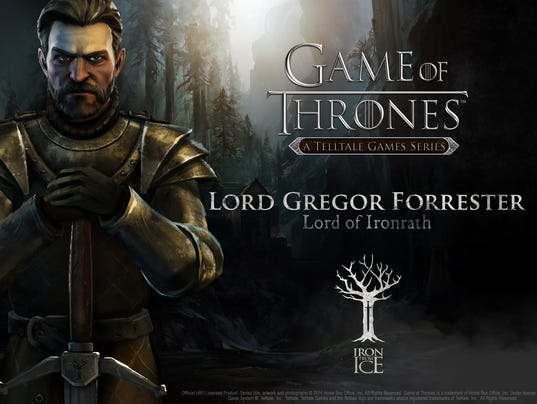
Here's an exclusive first look at Gregor Forrester, Lord of Ironrath, one of 13 house members that will make appearances in the episodic series. Here's how Telltale describes his role in the series:
"Lord Gregor Forrester is lord of a strong Northern House and a bannerman of House Glover, who are in turn loyal to the great house of the north – the Starks. As a youth, he famously arm-wrestled Galbert Glover for the privilege of becoming the man's squire; Glover later joked that he'd gladly lose the match all over again. After his father died at the Trident, Gregor ascended to the lordship, and married Elissa Branfield at the behest of Robert Baratheon."
The story will be told from five different characters' perspectives, each representing a member of the House of Forrester.
Like Telltale's previous work such as The Walking Dead and The Wolf Among Us, Game of Thrones will be an episodic series spanning six chapters released over the course of several weeks.
Recent Telltale titles require players make difficult choices that impact the direction of the story. The developer says Game of Thrones will follow that same path when it launches for PC, Mac, PlayStation 4, PS3, Xbox One, Xbox 360 and Apple's iOS mobile system.

Popular Posts

Archive

TOP TECH NEWS, All Rights reserved. Powered by Blogger.